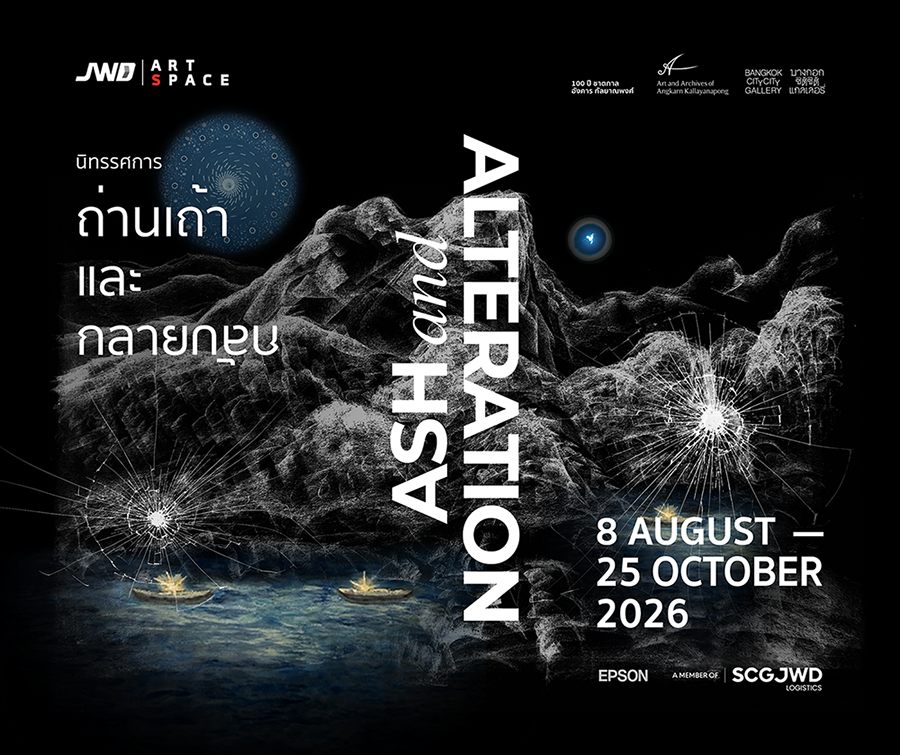
In the literary landscape of the Cold War era, Angkarn Kallayanapong’s poetry is littered with ruins. His writings are inhabited by funeral pyres, fossils, and ashes. This imagery also resonates with the origin of the name Angkarn—not his birth name, but one forged through the experience of personal collapse. The word “Angkarn” carries multiple meanings; among them are the ashes left behind after destruction and dissolution. Like the late artist-poet himself, these ashes remain as traces of thought and evidence of a life once lived, preserved through artworks, sketches, and archival records. The exhibition Ash and Alteration begins with a question about these traces. On the occasion of the centenary of Angkarn Kallayanapong’s birth, a convergence of opportunity, circumstance, people, draft manuscripts, archival documents, letters, spaces, and time invites viewers to encounter Angkarn through his own remnants: the ashes, fragments, and papers he left behind as inheritance, as representation, and as the material imprint of his mind.
In another sense, dissolution is the dismantling of an existing structure in order to become something new. Things disintegrate so that other things and beings may continue. Or perhaps dissolution is the act of walking upon ruins, of retracing the past while imagining the future. In this exhibition, Chulayarnnon Siriphol and Tada Hengsapkul revisit the Buddhist philosophy and ideals of nature that permeate Angkarn’s work through formal experimentation and a movement away from familiar landscapes toward new territories, from idealized visions to decay, from the light of wisdom to the light of destruction.
The traces preserved within the archive, at once a site of remembrance and forgetting, are woven together into an incomplete portrait of the painter-poet, one inextricably bound to those around him and to the history of his time. Scholars of literature and visual art, Jirat Chalermsanyakorn, Prapan Jangkitchai, and Artit Srijan, have collaborated to reinterpret the archive of Angkarn Kallayanapong, to highlight his place within the histories of both art and literature, and to foster a dialogue between the visual and literary arts. This dialogue constitutes one of the most enduring intellectual legacies of Angkarn Kallayanapong.